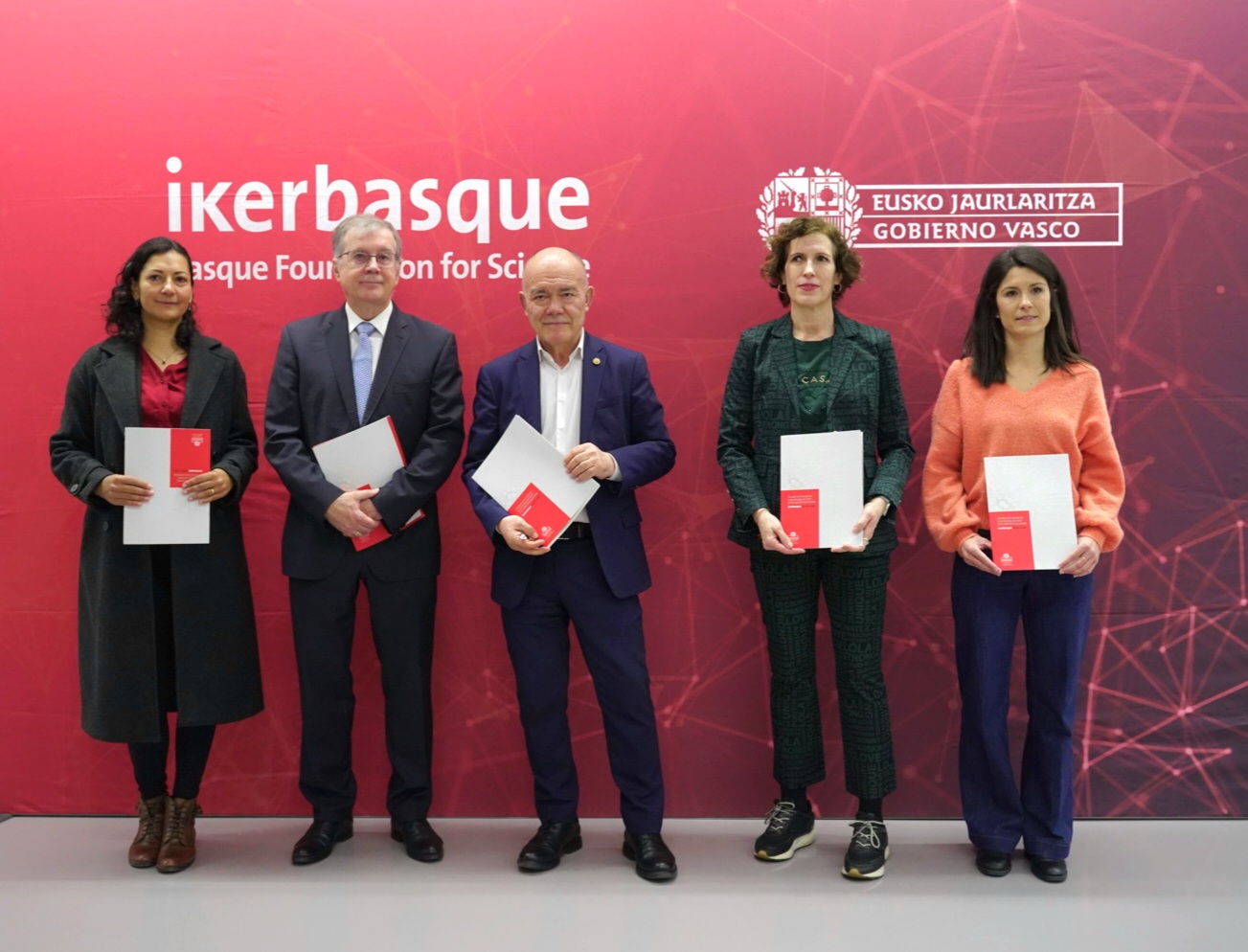
During 2025, Ikerbasque attracted 30 new researchers, bringing the Ikerbasque community to a total of 417 professionals, and secured more than €49 million in research funding. These are some of the most significant figures in the annual report presented this morning by the Minister for Science, Universities and Innovation, Juan Ignacio Pérez Iglesias; Ikerbasque Scientific Director Fernando Cossío; and Amaia Esquisabel, Director for Science Policy. Two Ikerbasque researchers, Mariana Medina and Irati Garmendia, also took part in the presentation.
According to the report, at the end of 2025 Ikerbasque brought together a total of 417 researchers across three key categories for the development of a scientific career: 214 established researchers with extensive experience and leadership capacity; 107 young researchers, with the aim of building a high-level scientific talent pipeline; and 96 Research Associates, an intermediate category that helps complete the different stages of the research career path. This structure not only strengthened research excellence, but also boosted scientific output, reflected in the publication of 1,726 articles in high-impact indexed international journals.
During the same year, funding secured by Ikerbasque researchers reached €49 million, €2 million more than in 2024, and 1,346 research projects received external funding. Among them, 5 new projects supported by the European Research Council (ERC) stand out. The ERC is the most prestigious organisation in Europe for supporting frontier scientific research. As a result of this momentum, 1,685 professionals were working at the end of the year in research groups led by Ikerbasque researchers.
In addition, Ikerbasque’s impact also extended to the business sphere, through participation in 48 spin-offs (business initiatives based on the exploitation of new processes, products or services derived from the knowledge and results obtained through research).
The researchers attracted by Ikerbasque from around the world to work at universities and R&D centres in the Basque Country come from 35 countries and are predominantly male: 69% men compared with 31% women. In terms of fields of expertise, 44% specialise in experimental sciences and 26% in medical sciences. A further 16% specialise in engineering, and 14% in social sciences and the humanities. Ikerbasque researchers come from some of the most prestigious institutions in the world, including MIT, Harvard University, Oxford, Stanford, CNRS and Max Planck.
The results achieved in 2025 confirm that the Basque Country is positioning itself as a European benchmark in science, internationally recognised as a region with advanced research, world-class Basque research groups, and the right conditions for carrying out research of international standing. One sign of this is that the European Commission has selected Ikerbasque’s researcher attraction programme as one of the best European initiatives for scientific development on six occasions, bringing Ikerbasque €28 million in funding from the European Commission.
In the words of Fernando Cossío, Scientific Director of Ikerbasque: “Some of the keys to Ikerbasque’s success lie in the independence maintained throughout the selection and evaluation processes, the outstanding quality of the Scientific Committee, the scientific excellence of the researchers attracted and their alignment with the strategic objectives of our science policy, and above all in the commitment to serve the entire Basque science and technology network.”
Likewise, the Minister for Science, Universities and Innovation, Juan Ignacio Pérez Iglesias, highlighted that in 2025, in line with the forecasts set out in its Strategic Plan, Ikerbasque decisively strengthened its position as a Foundation for Science by expanding and diversifying its functions as a catalyst for cutting-edge science in the Basque Autonomous Community. “After initially focusing on the attraction and development of research talent, it went on to play a more active role in the management of research activity (through its participation in the governance of several BERCs) and last year it also took on the management of scientific infrastructures, such as the Ikerbasque Centre in Donostia, which houses the IBM Quantum System Two,” he stressed.
Host institutions
As for their host institutions, 128 Ikerbasque researchers are affiliated with EHU. The remaining 289 have joined other universities (Deusto and Mondragon Unibertsitatea) and research centres, including the nine BERCs (Basque Excellence Research Centres) and the four Cooperative Research Centres under the Department of Science, Universities and Research.
The full list of existing BERCs and CICs is as follows:
- Achucarro – Basque Center for Neuroscience
- BCMaterials – Basque Center for Materials, Applications and Nanostructures
- Polymat – Basque Center for Macromolecular Design & Engineering (Donostia)
- DIPC – Donostia International Physics Center (Donostia)
- CFM-MPC Materials Physics Center (Donostia)
- Biofisika Institutua – Basque Centre for Biophysics of Biscay (Leioa)
- BC3 – Basque Centre for Climate Change
- BCAM – Basque Center for Applied Mathematics (Bilbao)
- BCBL – Basque Center on Cognition, Brain and Language (Donostia)
- CIC biomaGUNE
- CIC bioGUNE
- CIC energiGUNE
- CIC nanoGUNE
In addition to these centres of excellence and the three aforementioned universities (EHU, Deusto and Mondragon), other institutions hosting Ikerbasque researchers include the health research institutes Bioaraba, Biobizkaia and Biogipuzkoa; the research centres Azti, Neiker, Tecnalia and Tecnum (University of Navarra); as well as Globernance (a centre for research and dissemination of political thought) and IISL/IISJ (the Oñati International Institute for the Sociology of Law). In total, 25 Basque universities and research centres benefit from the attraction of international researchers.
Some notable researchers
Two of the new researchers joining Ikerbasque took part in today’s press conference:
- Mariana Medina (Bogotá, 1982) earned her PhD at the Autonomous University of Barcelona and, after more than 10 years of research experience at IIN (Integrative Nanosciences) in Germany, where she secured an ERC grant, she has joined CIC nanoGUNE. Her research focuses on the development of small-scale medical devices, including ultrasensitive biosensors and medical microrobotics.
- Irati Garmendia (Gipuzkoa, 1989) earned her PhD at the University of Navarra and, following a postdoctoral stay at the Centre de Recherche des Cordeliers (Paris), is currently conducting research at Biogipuzkoa focused on the study of inflammation associated with lung cancer.
.png)

