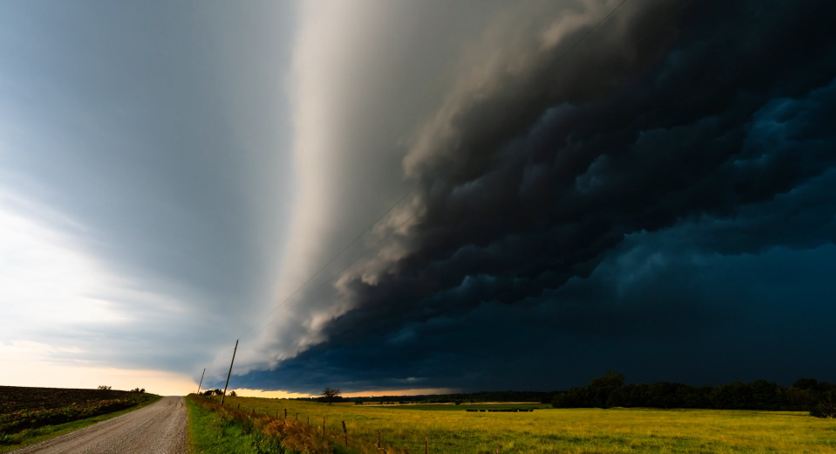
The movement of ocean currents and air masses in the atmosphere is governed by physical laws of enormous complexity. Understanding them is key to predicting everything from the global climate to the formation of a tornado. However, current mathematical models often have to simplify reality in order to remain manageable. A project led by Ikerbasque researcher Francesco Fanelli at BCAM – the Basque Center for Applied Mathematics – aims to overcome these limitations by developing a more rigorous and precise theoretical framework.
The research focuses on “geophysical fluids,” whose large-scale dynamics are determined by the competition between gravity and the Earth’s rotation (the Coriolis force). The goal is to create models that incorporate crucial factors that are often left out today, such as variations in density and temperature, or the interaction of the fluid with ocean-floor topography and land relief.
As Francesco Fanelli explains, the problem lies in the excessive simplification of current models: “The models we use today in meteorology are a necessary simplification, but they often omit crucial details. They are like maps that fail to accurately represent mountains or the seafloor. In doing so, they lose reliability, and it becomes difficult for them to provide a complete description of the actual physical process. Our goal is to understand these issues from a theoretical perspective, using the rigorous tools of mathematics, in order to build models that capture the missing complexity.”
Francesco Fanelli’s research at BCAM is being developed along three main lines:
- Incorporating greater physical complexity: The aim is to include thermal effects, density variations, and interaction with non-uniform surfaces in the models.
- Analyzing singular structures: The research pays special attention to the dynamics of high-impact phenomena, such as tornado formation, the evolution of large ocean vortices, and regions of high turbulence.
- Deriving simplified but robust models: The objective is to obtain, in a mathematically rigorous way, models that are simpler than full reality, yet reliable and relevant for improving numerical simulations.
Although this research is theoretical in nature, its future implications are far-reaching. By providing a deeper understanding of fluid dynamics, it will lay the groundwork for a new generation of simulation tools that could revolutionize weather forecasting and the study of climate change. “History is full of examples where basic science has unexpectedly generated practical contributions,” Fanelli concludes. “Our work consists of building that fundamental, rigorous, and verified knowledge that will serve as a pillar for the applied advances of tomorrow.”
.png)

