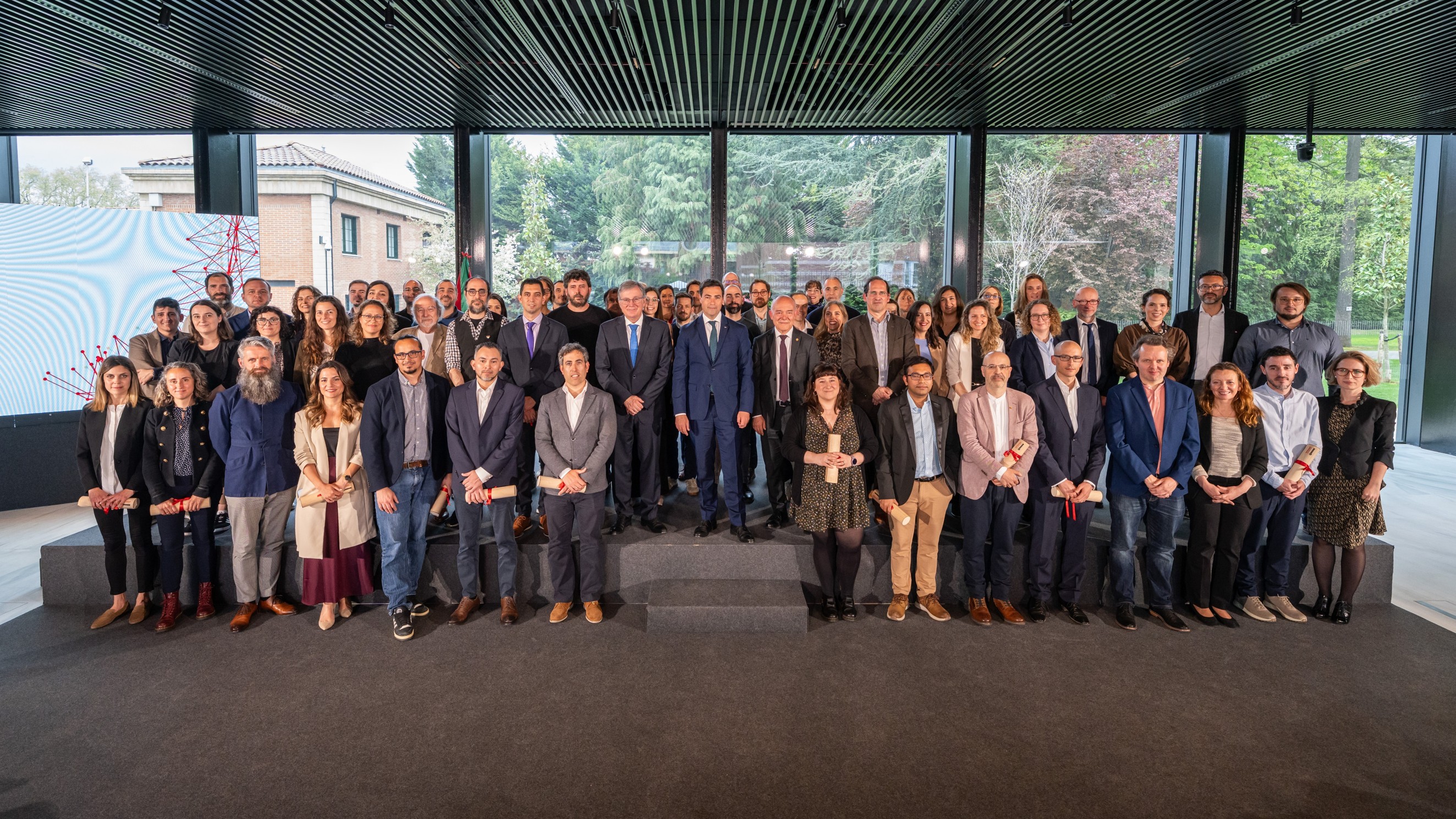
The Elkargunea space at Ajuria Enea Palace hosted the reception that Lehendakari Imanol Pradales offered to the latest researchers joining Ikerbasque. During 2024 and 2025, a total of 77 researchers—from across all fields of knowledge—have chosen to carry out their work at universities and research centers in the Basque Country through Ikerbasque.
After presenting awards to the new research staff, the Lehendakari emphasized the importance of “continuing to invest decisively in science and research in the Basque Country.” He stated that the Basque Country has increased investment in R&D by 6.1%, reaching €723 million, with a 12.8% increase in training and professional development programs for research staff, and a 35% increase in the postdoctoral program. Pradales highlighted Ikerbasque’s role as a key agent and catalyst for cutting-edge science in our country, concluding: “we have a long-term vision.”
“We are reducing the bureaucratic burden on research groups, incorporating the dimension of emotional well-being, and promoting female leadership. And we have set the direction to follow, aligning Basque R&D with the Country’s priorities through the PCTI and the Innovation Lighthouses. Because we are clear that science is an essential part of Culture,” the Lehendakari underlined.
For his part, the Minister for Science, Universities and Innovation stressed that the people who have come to or returned to the Basque Country attracted by the Ikerbasque program, although they represent only a very small fraction of the total research staff working in Euskadi, make a highly significant contribution to the development of science in the Basque Country. “They are responsible,” he stressed, “for very important scientific contributions in their respective fields, they have created top-level teams, they account for all ERC projects (ERC Grants) based in our science and innovation system, they secure external funding for their projects that doubles the program’s own budget, and one tenth of these individuals have created a science-based company.” For all these reasons, the Minister emphasized that “the science policy implemented by those who came before us has had major successes; few have been as fruitful as the Ikerbasque program.”
The event also featured the participation of Fernando Cossío, Scientific Director of Ikerbasque, and four of the new researchers joining Ikerbasque. Among those attending the reception were representatives of the 22 institutions—universities and research centers—where these 77 individuals work.
Research career
The 77 researchers joined Ikerbasque through different calls. The Research Professor category is aimed at established profiles with extensive international experience and leadership capacity. In the last two years, 15 researchers have joined in this category.
The Research Fellow program is designed to attract and retain in the Basque Country young researchers with high potential in different fields of knowledge, with the aim of building a pipeline of talent. Through this program, 51 people joined between 2024 and 2025.
These two categories are complemented by the Research Associate Professor program, conceived as an intermediate stage between them. Through this route, 11 people have joined.
At present, Ikerbasque has 417 researchers—Research Professors (214), Research Associates (96), and Research Fellows (107)—integrated into the Basque System of Science, Technology and Innovation. Universities and R&D centers in the Basque Country benefit from the contribution of expert professionals in multiple disciplines, from experimental sciences to the humanities, including medicine, engineering, and social sciences.
Extensive international experience
During the event, four of the new recruits shared their professional experience. Among them were the Basque researchers Leire Bejarano and Virginia Ruiz Garate. Bejarano, after developing her scientific career in Switzerland, Belgium, and various centers in Spain, joined Biogipuzkoa to continue her research on brain tumors. Ruiz Garate, meanwhile, after conducting research at leading centers in Italy and the United Kingdom, joined Mondragon Unibertsitatea to advance in the field of biointelligent robotics applied to healthcare and industrial environments.
Meanwhile, Irish researcher Brendan Costello joined the Ikerbasque team through BCBL, a center where he had already been conducting research for several years. He holds a degree in Computer Science from the University of Cambridge and in English Philology from the University of the Basque Country (EHU), and a PhD in Linguistics from EHU and the University of Amsterdam. Among his most recent work is the study of sign language and reading in the brain.
Finally, Colombian-born researcher Camilo Umaña, after a long international career that includes stays at the Harvard Kennedy School and the Center for Latin American Studies at Brown University, joined the International Institute for the Sociology of Law in Oñati as Scientific Director.
.png)

