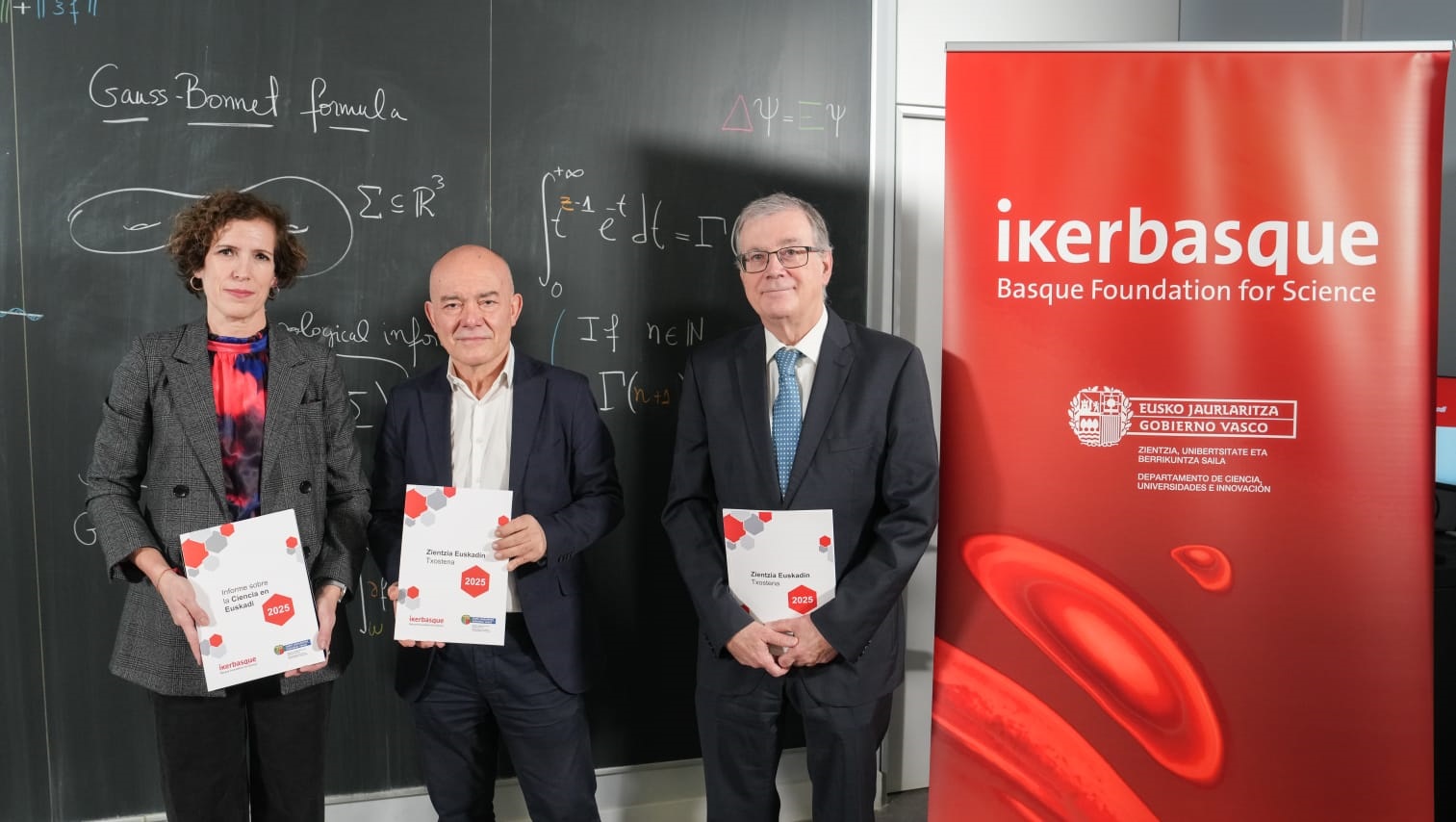
This morning, at the headquarters of BCAM —the Basque Center for Applied Mathematics— the 2025 Report on Science in the Basque Country was presented. The event was attended by the Basque Government’s Minister for Science, Universities and Innovation, Juan Ignacio Pérez Iglesias; the Director of Scientific Policy, Amaia Esquisabel; and the Scientific Director of Ikerbasque, Fernando Cossio.
2025 Report on Science in the Basque Country
Minister Pérez Iglesias summarised the most significant findings of the new report and highlighted that our community has a rich and diverse research ecosystem, led by the public university and noted not only for the volume of its scientific output but, above all, for its quality.
The report compiles the Basque Country’s main results regarding research personnel, science funding, scientific output and technology transfer, using the indicators monitored by Ikerboost, the Basque Observatory for Science and Technology.
When analysing the role played by society in scientific activity, the report notes that more than 36,000 people work in the field of Research and Development. Of these, 24,455 are dedicated specifically to research tasks, representing more than 2% of the Basque Country’s active population. Thanks to this broad professional community, the number of scientific publications has experienced remarkable growth: in 2024, the Basque Country reached nearly 8,200 annual publications — specifically 8,190. Moreover, the quality of this research output has also improved significantly, as 64% of the work was published in first-quartile journals, considered the most prestigious.
Also noteworthy is the evolution of the internationalisation of scientific output, which has grown by almost 15 percentage points over the past decade: from 40% of publications involving international collaboration in 2011 to 55% in 2024. In such work, researchers from the Basque Country play a prominent role and, in many cases, appear as leading authors. To disseminate their results, they collaborate with the world’s leading knowledge-generating countries —the United States, Germany, the United Kingdom, France, and Italy— as well as with internationally renowned research centres, including France’s CNRS and the universities of Oxford and Cambridge.
Despite these positive results, the report notes that the growth of the research population has not significantly reduced the gender gap. In 2023, the percentage of women in full-time equivalent (FTE) positions barely exceeded 35%, with no perceptible trend of improvement over the last decade. In response, the Minister stressed that both the four-year support programme for university research and the programmes of the Cooperative Research Centres (CICs) and the Basque Centres for Research Excellence (BERCs) for 2026–2029 include specific measures to promote greater gender balance.
Investment and economic return
According to the latest data published by Eustat, the Basque Country has reached its highest investment in R&D, surpassing €2 billion for the first time (an increase of 11.5%). This figure represents 2.35% of GDP, once again placing the Basque Country as the autonomous community that invests the most in R&D.
The Basque Country is also the leading Autonomous Community in per-capita return from the European Horizon Europe programme, having secured €124 million in 2024. Over the past ten years, the region has attracted €1.378 billion, funding that is reinvested in new programmes and new scientific hires.
Within this programme, the ERC grants of the European Research Council stand out in particular. These projects support researchers of any nationality and age who wish to push the frontiers of knowledge. Over time, ERC grants have become an international benchmark of excellence, due both to the high number of proposals received and to the rigorous evaluation process. In the Basque Country, 57 ERC projects have been carried out and 30 are currently underway, the highest number to date.
Regarding scientific output by sector, Basque universities account for 67% of all publications generated in the region. Among them, the University of the Basque Country (EHU/UPV), the region’s main scientific institution, contributed around 4,500 indexed publications in 2024. Following the university sector are the healthcare sector, the BERC centres, technological centres and the CICs. In recent years, cooperation among universities, BERCs, CICs, the healthcare sector and technological centres has continued to grow steadily.
Over the past decade, the main thematic areas in which the Basque Country conducts research have remained stable; the area with the highest number of publications is Medicine, followed by Engineering, Materials Science, Computer Science, Physics and Astronomy, and Chemistry. Furthermore, over the past ten years, productivity in the Social Sciences and Humanities has experienced a very significant increase.
It is also worth noting that around 7.3% of the Basque Country’s scientific output is cited in patents, once sufficient time has passed between the generation of new knowledge and its application.
.png)

