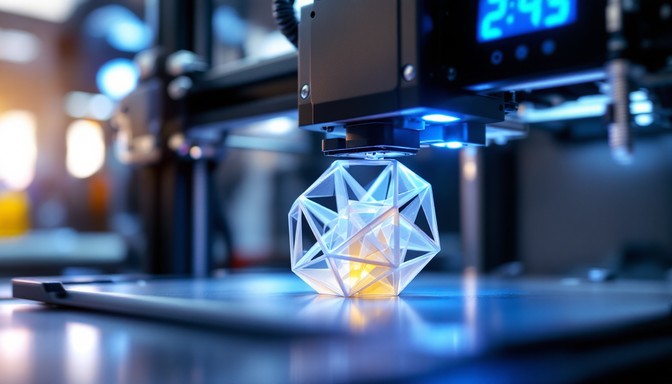
One of the main limitations of current 3D printing is the lack of materials with advanced mechanical properties, especially when flexibility, elasticity, and strength need to be combined. The commercially available resins are often rigid and brittle, which limits their use in functional applications and in demanding industrial sectors.
The Hevea3D team, a spin-off emerging from POLYMAT and the University of the Basque Country (EHU), has developed a new generation of resins for 3D printing that makes it possible to manufacture parts with mechanical behavior comparable to industrial rubber. The technology is based on polymer emulsion resins, similar in appearance to water-based paint, which can be solidified with light without losing their original properties.
This approach makes it possible to manufacture elastic parts layer by layer without the need for molds, significantly reducing development times, associated costs, and waste generation. As a result, it is possible to go from a digital design to a functional part in just a matter of hours, representing a significant shift compared to conventional manufacturing processes.
The technology opens up new possibilities in sectors such as automotive, soft robotics, sports, aerospace, and healthcare. Its potential applications include the manufacture of components such as customized prostheses tailored to each patient without incurring prohibitive costs, functional prototyping, and the commercialization of advanced resins.
In addition to its industrial impact, Hevea3D’s proposal stands out for its focus on sustainability. As it is a water-based additive manufacturing system, it minimizes the use of harmful solvents both during printing and post-processing, while also significantly reducing raw material consumption and waste generation.
The development of this technology is the result of collaborative work between POLYMAT, the University of the Basque Country (EHU), and Arizona State University, with the support of organizations such as Ikerbasque. The scientific and technological potential of the proposal has recently been recognized with the Manuel Laborde Award 2025, which honors knowledge transfer initiatives with high impact.
Hevea3D is currently working on the industrialization of this technology with the aim of bringing scientific advances in polymer materials into real solutions for the industrial sector.
.png)

